Louise's obsession with family belonging and newborns
Chanson douceLouise’s fixation on a new baby is the point at which her longing to belong to the Massé household becomes an imagined claim on its future. She pictures an infant as a source of shared affection, a reason for Paul and Myriam to remain close, and a guarantee that she will continue to be needed. The fantasy offers her a place in the family, but its increasingly desperate logic turns the children already in her care into obstacles to the family she believes she must help create.
The fantasy of a shared family
The idea comes to Louise while she is lying beside Hervé in his home. Her attention shifts from the encounter to an imagined newborn: a child wrapped in the warmth of new life, dressed in pastel rompers, and passed between her own arms and those of Myriam and Paul. In her vision, caring for the baby would draw the adults together, erase misunderstandings, and give their habits renewed purpose. The child is not imagined only as someone to nurture; it is also the bond that might secure Louise’s place among the people she serves.
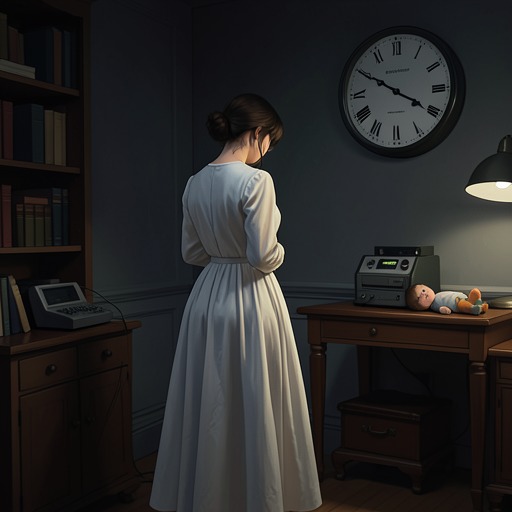
The fantasy quickly enters the routines of the Massé apartment. The following day Louise makes Paul and Myriam’s bed with unusual care, running her hand across the sheets and looking for evidence of their intimacy. She asks Mila whether she would like a little brother or sister whom they could care for together. Louise hopes that Mila will carry the suggestion to her mother, and the child eventually asks Myriam whether she has a baby in her belly. Louise watches with delight, but Myriam laughs and dismisses the possibility. The gap between Louise’s anticipation and Myriam’s casual answer exposes how differently they understand the prospect: Louise treats it as a future on which her belonging depends, while Myriam does not share that investment.
Work, dependency, and imagined necessity
Louise’s hope is inseparable from her position as a paid caregiver. She reasons that when Adam starts school in September, the home will be empty and she will have nothing to do. A third child, by contrast, would mean that the Massés could not manage without her. She tells Wafa that a baby would bring her joy as well as extra work, making explicit the practical calculation beneath the dream of closeness. The infant promises both emotional inclusion and continued employment.
This calculation unfolds within an unequal relationship already visible in the family’s search for a nanny. Paul has prepared interview questions and set conditions for candidates, including that the caregiver be available and able to work so the parents can work. Myriam, meanwhile, is troubled by advice from Emma that a nanny’s children should be left in her home country for the employer’s convenience. Their search makes the employer’s power to assess a caregiver’s family circumstances plain. Louise’s imagined solution is to make herself indispensable within the household, but it cannot undo the boundary between employee and family member on which her hope depends.
Her contact with Wafa offers a contrast in women’s working and immigration circumstances, though not an escape from dependence. Wafa, who lacks papers, recounts how she came to France and describes a job with a couple who provide her with a room but, in exchange, leave her feeling unable to refuse them. Louise listens as Wafa confides experiences that will never be recorded elsewhere. Against this background, Louise’s desire for a baby is not simply domestic daydreaming: it is a bid for security within a life shaped by work, isolation, and uncertain claims to a place of one’s own.
Signs, rituals, and disappointment
Louise begins interpreting ordinary details as evidence that Myriam may be pregnant. She listens to the couple’s conversations, noting that Myriam now lowers her voice and closes doors when talking on the phone. She prepares rice pudding with cinnamon, spiced soups, and other foods she believes encourage fertility. Her observation of Myriam’s body and the care she gives to the household laundry take on the character of rituals directed toward the hoped-for child.
The hope repeatedly gives way to disappointment. Louise notices a mark on Myriam’s pajamas and a tiny spot of blood on the bathroom tiles. She understands the recurring blood as proof that no child is coming. The detail that Myriam scarcely notices becomes, for Louise, decisive: she reads the monthly sign as the death of a child she had already made part of her imagined future. The routine cycle of hope and loss governs her mood. Moments of euphoria give way to days when the world seems to contract, while the closed doors of Paul and Myriam’s private life become barriers she longs to force open.
From longing to a dangerous scheme
As the fixation intensifies, Louise recasts the baby as a solution to all her troubles. She imagines that a child would silence the women who criticize her at the square, make her landlord retreat, and protect her position in the household. In this reasoning, Mila and Adam become impediments: their needs exhaust their parents, and Adam’s light sleep, she believes, interrupts the couple’s intimacy. Louise’s longing thus changes direction. The baby remains the object of care in her fantasy, but she becomes willing to destroy whatever stands between her and its imagined arrival.
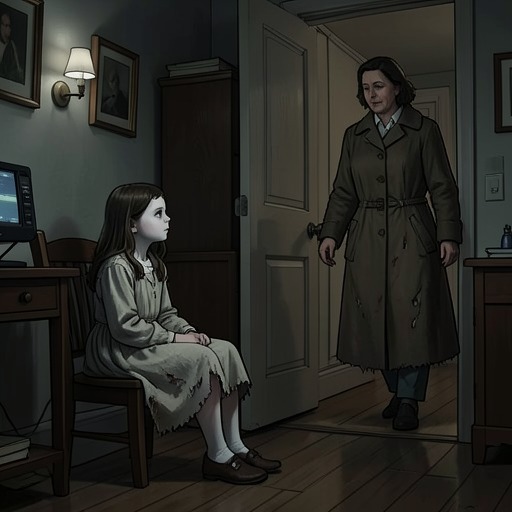
The change is visible in her conduct as well as her private reasoning. After Lydie’s stroller is overturned and the groceries spill into the gutter, Louise is already far away; Lydie later insists that the act was deliberate. The incident provides a concrete sign of hostility toward another caregiver, though the text’s central account of Louise’s motive is her all-consuming belief that the baby will resolve her problems and secure her realm. The distinction between nurturing and possession has become dangerously unstable.
One evening, Louise waits eagerly for Myriam to come home. She takes Mila by the hand and asks whether she can take the children to a restaurant so that Myriam and Paul can dine alone. The offer presents itself as a kindness, but Louise has planned it as an intervention: if the parents have time together, they might rekindle their intimacy and agree to another child. Myriam hesitates, and Mila begins pleading on Louise’s behalf. In this scene, Louise’s private fantasy becomes an attempt to arrange the family’s behavior, with Mila drawn into the plan as its unwitting or compliant intermediary.
Significance
The fixation reveals the contradiction at the center of Louise’s relationship with the Massés: she gives care within their home, yet the belonging she seeks is not guaranteed by that work. A baby seems to resolve the contradiction by turning her usefulness into a permanent bond. But the imagined bond depends on a child and a decision that belong to Paul and Myriam, not to Louise. The more she treats that desired future as essential, the more she confuses service, intimacy, and a right to remain.
The novel also places this private obsession beside the wider social arrangement of domestic childcare. The Massés’ interviews distinguish candidates by age, language, availability, and immigration status; Emma’s advice reduces a nanny’s children to a scheduling inconvenience. In the public spaces where caregivers meet, the women’s work and languages gather around children whose parents may later forget the caregivers and even the words they taught them. Louise’s desire to join the family is intensely personal, but its conditions are social: she is close enough to perform intimate care and far enough outside the family to fear that her place will disappear. The baby becomes her imagined answer to that distance—and the measure of how perilous her longing has become.